
The latest Israeli threats against the integrity of Iran's top leader, Ali Khamenei, and the possibility that US forces will join Tel Aviv's offensive against the ayatollahs' regime have accentuated the spiral of tension in the Middle East, forcing Washington to withdraw planes and ships from Qatar and Bahrain.
Satellite images and local sources cited by Arab media and CNN confirmed that the United States has evacuated dozens of fighter jets from the Qatari base of Al Udeid, on the outskirts of Doha, due to its proximity to Iran.
Al Udeid is not only the headquarters of US forces in the region but also a global strategic reference point for Washington since it was used as a key element in the First Gulf War (1990-91).
The facility houses nearly 10,000 US military personnel and was visited by President Donald Trump himself last May. The US Embassy in Doha acknowledged Thursday that"access to the military complex has been temporarily restricted."
US sources quoted by Reuters confirmed the withdrawal from Al Udeid and an undetermined number of ships that were located in Bahrain, headquarters of the US Fifth Fleet."Protection is a priority", said the aforementioned representative.
Iran's military commanders have made it clear that if Washington attacks their territory, all facilities housing Iranian troops will be targeted. CNN's Arabic service estimated that Iran has nearly 40,000 troops in the Middle East, deployed across at least 27 bases.
"If conflict is forced upon us, the United States must leave the region. All of their bases are within our reach, and we will attack them without hesitation in the host countries," Iranian Defense Minister General Aziz Nasirzadeh said a few days ago.

Caught up in the spiral of violence initially unleashed by the Israeli bombings, the region's various political and armed actors appear to be preparing for a direct confrontation between Washington and Tehran that could have catastrophic consequences for the entire region.
According to Iranian spokesman Mohsen Rezaei, his country's forces have so far launched some 400 missiles and 600 drones against Israel, which, according to him, constitutes 30% of its capabilities.
Rezaei added that Tehran has not yet resorted to its naval forces, its military, or the possibility of closing the Strait of Hormuz, an action that would cause a global economic crisis by disrupting the significant portion of the world's fuel supply that transits through that waterway daily. Furthermore, Tehran appears to have reached out to allied paramilitary groups throughout the region to recruit their support in the event of an all-out war.
After keeping all these forces at bay since the beginning of the current crisis, a senior Iranian official completely changed his country's rhetoric on Wednesday, warning on Al Jazeera that"if the United States joins the front line alongside the Zionist entity [Israel], it would mean that Hezbollah will take action."
The statements of this Iranian representative could have been a mere exercise in verbiage typical of the current war euphoria, if it were not for the fact that a few hours later the secretary general of the Lebanese movement - who until now had repeated that he would not participate in the war - also made a significant change in his statements and said that Hezbollah"is not neutral" in this confrontation.
"We will act as we see fit," he added in a statement.
Although Hezbollah has always maintained a certain autonomy from Iran, the truth is that the group is linked to the religious dictates of Ali Khamenei by the principle of the so-called Wilayat al Faqih , which demands absolute obedience. Therefore, when Tehran demanded it, the Lebanese group got involved in the Syrian civil war alongside the regime of Bashar Assad , despite the controversy that this decision generated among its own followers and the total discredit that it brought it in the region, especially among the Sunni majority.
Party members, quoted by the publication Middle East Eye, indicated that the death threats from Israel against Khamenei are"a red line" that, if carried out, would also change the attitude of the Party of God."If the survival of the regime is called into question, it is quite possible that Hezbollah will intervene," said analyst Ali Rizk, speaking to the same publication.
To date, Beirut's official position is that its country will remain out of the conflict.
The Lebanese capital hosted the US special envoy for Syria and ambassador to Turkey, Thomas Barrack, on Thursday. Barrack immediately stated that any involvement by Hezbollah in this conflict would be"a very, very, very bad decision." Israeli Defense Minister Israel Katz countered that if the irregulars resume their actions against his country, they will cease to exist."There will be no Hezbollah," he said.
Hours later, Israeli aircraft attacked at least four areas in the south of the country, accusing them of hitting"Hezbollah military and rocket launcher positions." An Israeli spokesman, Avichay Adraee, accused the Lebanese group of"trying to rebuild its capabilities."
Katz is making a name for himself with his incendiary rhetoric, and it was precisely his remarks against Khamenei that have also modified the reaction of Iraqi groups close to Tehran, and even of the highest religious leader of the Shia minority, Grand Ayatollah Ali Sistani .
The latter commented on Thursday that a hypothetical assassination of Khamenei would cause"general chaos" throughout the Middle East, adding that it would"seriously damage the interests of everyone."
Sistani's standing among Shiites is such that when he issued a fatwa (religious edict) in 2014 calling on Iraqis to mobilize against the then-ongoing Islamic State offensive, tens of thousands immediately took to the streets and joined the plethora of militias still active today.
The dozens of militias grouped together in the so-called Popular Mobilization Forces (FMP) comprise tens of thousands of fighters—they claim more than 200,000—and have a significant force of both drones and missiles.
Two of them, Nujaba and Hezbollah Iraq, have already warned that they will join the war in the event of any attack against Khamenei or if the United States directly participates in the Israeli offensive.
"If you touch a hair on Khamenei's head, you and your allies will be under our fire. No soldier or diplomat will go unpunished. Every person of your nationality will be a legitimate target," Nujaba leader Akram al-Kaabi said in a statement.
Washington is also evacuating staff from its large diplomatic mission in Baghdad, according to several Iraqi media outlets, which also reported on the general alert issued by paramilitary groups whose top leaders have decided to go into hiding, fearing possible bombing by the United States or Israel.
A spokesman for Hezbollah Iraq, Abu Ali al-Askari, explained that if the US intervention leads to an all-out war in the region, the US bases"would become a game of ducks" and its supporters would be part of a general plan to paralyze all maritime traffic in the region, including the transport of oil and gas.
Prime Minister Mohammed Shia al-Sudani has spent many days trying to strike a balance between the country's policy toward the West—the United States still maintains nearly 2,500 troops in the country—and these pro-Iranian groups, which decided to end their attacks against Israel in support of Gaza at the end of last year and are now reconsidering their course of action.
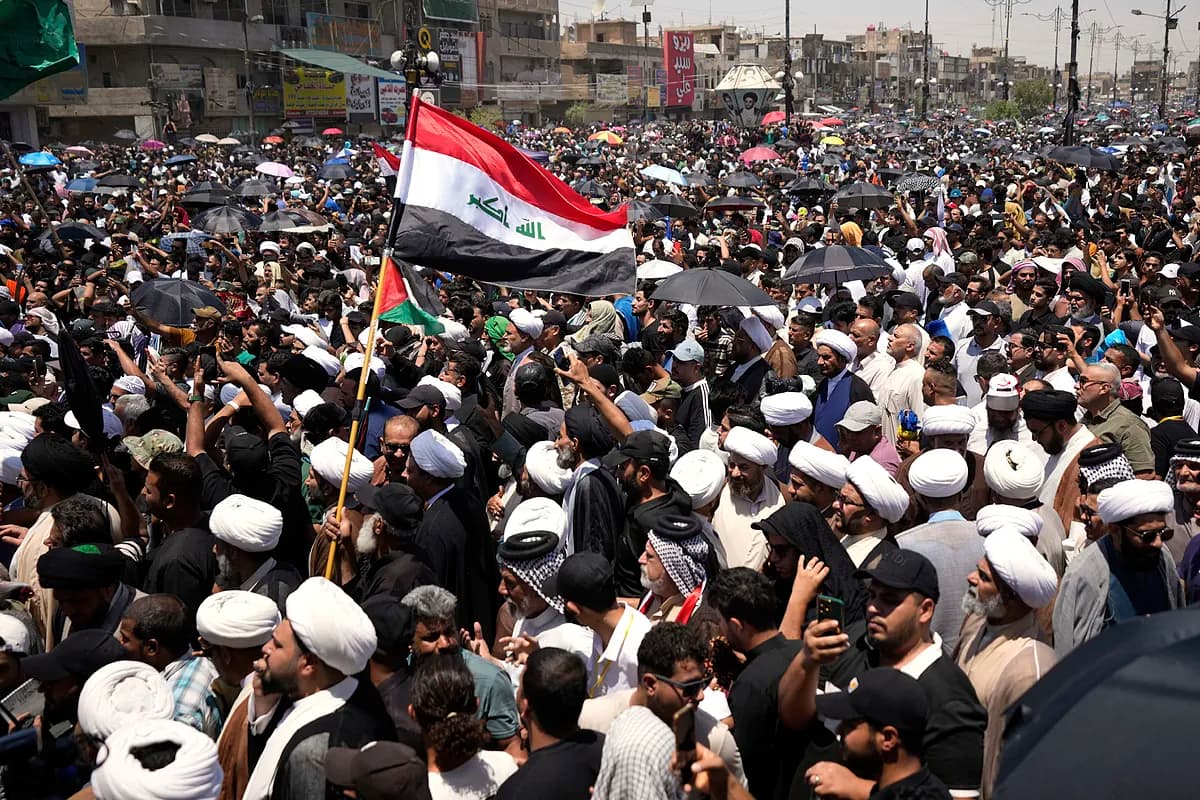
Hundreds of thousands of people demonstrated again this Friday in support of Iran in response to the call made by another key figure in local politics: Muqtada al Sadr.
Although Sadr himself had asserted in a tweet that"Iraq and its people do not need more wars," the cleric—whose militants have already engaged in violent conflict with the Americans in the past and even fought such symbolic battles as the siege of Najaf in 2004—has also joined those reacting angrily to Katz's outbursts in recent hours.
Demonstrations in support of the Iranian regime are multiplying in Iraq, coinciding with calls from pro-Iranian politicians for an accelerated withdrawal of US troops from the country. According to the agreement reached between the two parties, they could remain until the end of 2026.