
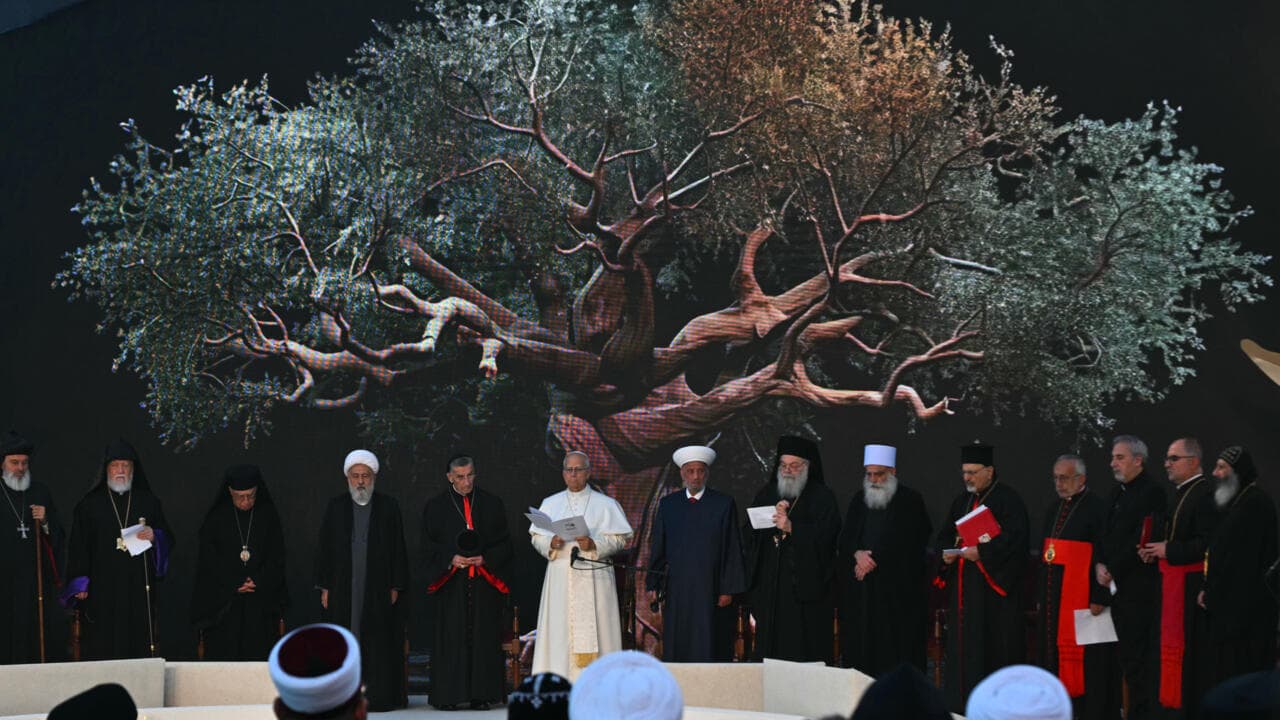
Christian and Muslim leaders gathered on Monday as Pope Leo XIV urged them to work for peace in their divided nation.
As the call to prayer was heard from the nearby Mohammed al Amin mosque, located next to a church, clerics gave speeches and a children's choir sang Christian and Muslim hymns.
Speaking from Martyrs' Square – which served as a demarcation dividing Beirut along sectarian lines during Lebanon's 1975-1990 civil war – Pope Leo called on the leaders to be"builders of peace: to confront intolerance, overcome violence and banish exclusion, illuminating the path toward justice and concord".
The pope sat surrounded by the spiritual heads of 16 Muslim and Christian denominations, out of the 18 recognised by Lebanon. The Jewish and Ismaili faiths were not represented, as those recognised communities have very few members remaining in the country.
Under a pavilion erected for the occasion, the leaders stood on a stage bearing the word"peace" in French and Arabic.
The meeting"highlights that Lebanon is a country with great experience in dialogue and meetings between sects", said Nayla Tabbara, founder of the Adyan foundation, which focuses on interreligious rapprochement.
"Even in the most difficult times, this dialogue has continued," she added, saying that the pope wished to show that"solidarity that transcends affiliations does not exist in any other country" in the region.
Symbolic olive tree
Lebanon's religious diversity is reflected in its political system.
The president of the republic must always be a Maronite Christian – the only Christian leader in the Arab world – while the prime minister must be a Sunni Muslim and the speaker of parliament a Shiite Muslim.
But political and religious divisions have repeatedly been exacerbated by Lebanon's many crises, most recently the war between the Iran-backed militant group Hezbollah and Israel.
Shiite militants from Hezbollah opened a"solidarity front" with its ally Hamas in Gaza by launching rockets at Israel, sparking anger in other Lebanese communities.
Pope Leo's visit – part of his first trip abroad as pontiff and after a visit to Turkey –"underscores the importance of dialogue and coexistence in Lebanon", said Fuad Khreis, a Shiite cleric.
"Lebanon is strong because of its people and all its sects... We must stand together as one and talk to each other, especially in light of the difficult situation we are suffering through."
In his speech, Pope Leo said coexistence in Lebanon was"a mission that remains unchanged throughout the history of this beloved land: to bear witness to the enduring truth that Christians, Muslims, Druze and countless others can live together and build a country united by respect and dialogue".
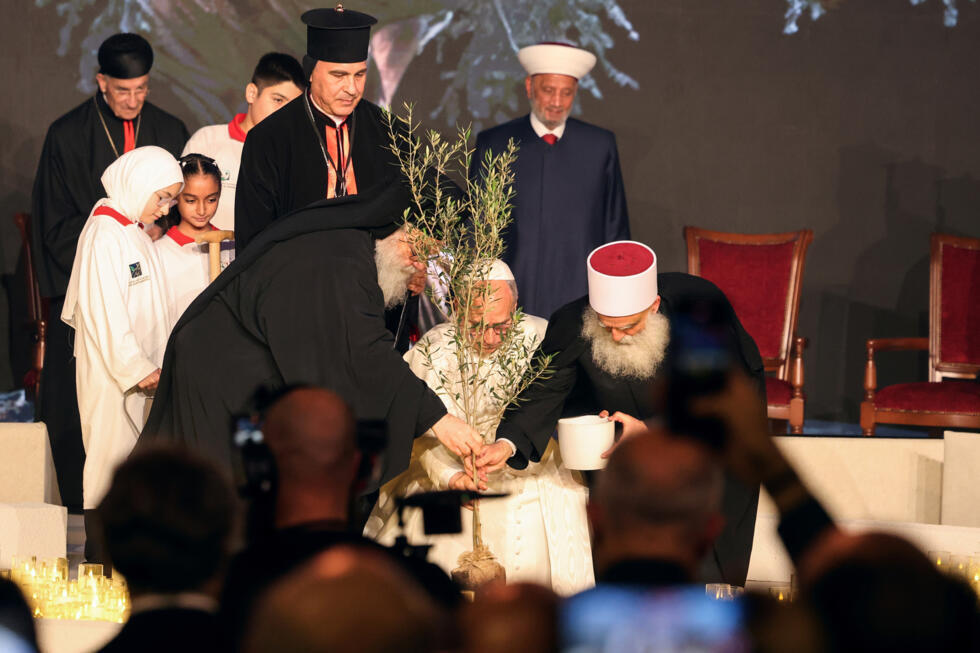
He concluded the meeting by planting an olive tree, saying it"not only adorns this space in which we gather today, but it is also revered in the sacred texts of Christianity, Judaism, and Islam, serving as a timeless symbol of reconciliation and peace".