

The U.S. government meeting had been scheduled for Thursday morning (Washington time) for days, but the first item on the agenda—the agreement between Israel and Hamas, announced the day before, on the first phase of Donald Trump's peace plan for Gaza—snuck in at the last minute."I believe this will be a lasting peace," Trump told members of his Cabinet."Remember, I've ended seven [wars]," he added, just one day before the Nobel Peace Prize, which he believes is his due."This is the eighth."
Trump boasted about his diplomatic strategy—which, after months of giving Prime Minister Benjamin Netanyahu carte blanche, changed following Israel's attack on Qatar, which enraged Sunni regimes—and insisted that he plans to travel to the region, although he did not provide details about when. He did say, in response to a reporter's question, that he would like to speak before the Israeli parliament (the Knesset)."If they ask me, I will do it. It would be a first for a president of the United States," he said, before adding that the Israeli government had suggested it. The day before, White House spokeswoman Karoline Leavitt announced that he would leave for the region on Friday after undergoing a medical examination that he had previously scheduled.
“We’ll see,” Trump responded to a question about whether the United States has assurances that Israel will stop bombing Gaza once it takes control of the hostages. This will happen “Monday or Tuesday,” according to the president. “The important thing, what everyone has been waiting for,” Trump added, “is the return of the hostages.” “Everyone is happy,” he added, referring to the rest of the Middle Eastern countries. Asked whether the Palestinians will be able to remain in Gaza, he stated: “Well, they know exactly what they have to do. Right now, you can’t live there.”
The Republican also spoke about Iran, a country he said he"wants to work toward peace." "They are fully in favor of this agreement. As you know, we have significant sanctions against Iran and many other measures. We would like them to be able to rebuild their country as well."
As he concluded his lengthy introduction, in which he discussed other national policy issues (from the persecution of antifascists to his immigration measures and the government shutdown), the President of the United States received glowing praise from Secretary of State Marco Rubio. What Trump achieved"will go down in the history of this country," he stated, prompting applause from the rest of the members of the administration.
The boss then warned them that,"given the busy day," only a few of them would be allowed to speak. This marked a change in the ritual of a meeting that is repeated more or less monthly and that in past years had lasted up to three hours, amid the president's ramblings and the embarrassing praise of his colleagues. This time, it was resolved in about 75 minutes.
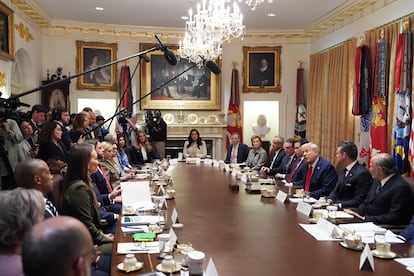
Among those granted permission to speak were Secretary of State Rubio, Secretary of Defense Pete Hegseth, Health and Human Services Secretary Robert Kennedy Jr., who championed the theory, not supported by most scientific opinion, that Tylenol causes autism if taken during pregnancy, and Vice President J. D. Vance. Vance took the opportunity to lash out at Senate Minority Leader Chuck Schumer—“one of the most famous Palestinians in the world,” he said of the Jewish politician. Agriculture Secretary Brooke Rollins spoke for the first time at a Cabinet meeting, under pressure from her boss to do so “very quickly.”
In the editorial pages of major American newspapers, normally critical of Trump, there were also praise for the president on Thursday, as well as timid calls for him to be awarded the Nobel Peace Prize this Friday, as he wishes."If the agreement survives," added the editorialists of The Washington Post."The Fake News media," Trump warned at the White House,"has covered [the news about the Gaza peace plan] very well, and I have to say they've been very fair this time."
The road to the “solid, lasting, and permanent” peace Trump seeks, as he wrote on social media Wednesday night, is long. For now, the agreement will set in motion the release of the remaining 48 Israeli hostages, an estimated 20 of whom are still alive, and the release of some 2,000 Palestinian prisoners. It will also allow the withdrawal of Israeli troops to half the Strip and the entry of humanitarian aid, which Israel had been blocking.
Chief Spokesperson
The announcement of the pact was made on social media by the US president himself, who, among his various responsibilities, has also reserved the role of chief press spokesman when the matter warrants it. The agreement comes two years and two days after the Hamas attack on Israeli soil, which was followed by a war and a brutal invasion that has left 67,000 dead and a destruction in Gaza with few parallels in modern history.
Trump spoke to his cabinet about the “almost 70,000” dead during Israel’s military campaign in Gaza, a figure he described as “great revenge” for Hamas’s attack on Israel on October 7, 2023, in which the Islamist militia killed some 1,200 people.
The signing, in the Egyptian town of Sharm el-Sheikh, commits the parties to comply with points 3, 4, 5, and 7 of the 20-part plan proposed by Trump. According to White House sources, this is just the beginning for the Republican, whose next goals in the region include getting more Arab countries to join the Abraham Accords, which he promoted at the end of his first presidency to break Israel's diplomatic isolation.
The United Arab Emirates, Bahrain, Sudan, and Morocco then joined in what its promoter defended as"the foundation of a comprehensive peace for the entire region." And then, Trump, too, deemed himself worthy of the Nobel Prize for this diplomatic achievement.