
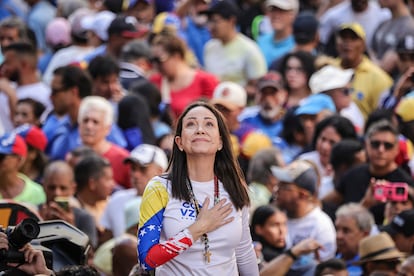
Barely a few hours have passed since the Norwegian Nobel Committee informed María Corina Machado (Caracas, 58) that she had been awarded the Nobel Peace Prize, a recognition the opposition leader hadn't even imagined. Machado, speaking through a screen—the only way to see her since she decided to live in hiding over a year ago—doesn't hide how overwhelmed she is. Between dozens of calls, she speaks with EL PAÍS about the implications of the award. Her broken voice, at the beginning of the interview, betrays a wealth of emotion.
At the time of the interview (9 p.m. in Spain, 3 p.m. in Venezuela), the Spanish government had still not congratulated him, and former Vice President Pablo Iglesias asserted that the Nobel Prize could have even been awarded posthumously to Hitler."Depending on who comes, attacks can be the highest praise," he asserted, referring to Iglesias's position. Regarding the government's silence, she remained cautious:"Very few hours have passed, and I don't dare to speculate because I myself haven't been able to answer the phone or speak to my children. But regarding the situation in Venezuela, there is no longer any room for silence or indifference, between crime and justice. No one wants to be in the middle. And in the end, I know who the Spanish are on the side of."
Question. What does this award mean at a time when Venezuela is going through one of its most critical periods?
Answer. I have no doubt that this will be a fundamental boost for us Venezuelans. We have never been closer to freedom than at this moment. We have tried everything in our Constitution to preserve freedoms and then recover democracy once the regime destroyed all institutions and rights. We have protested and we have been trampled on, attacked, and assaulted; we have gone to elections, defeated the regime, and the election was stolen. We have participated in multiple negotiation processes, and the regime has broken its word in every one of them. So we are at a moment in which we have understood that only the coordination of internal and external forces against a criminal structure will allow Venezuela to advance in the democratic transition. And we are on the threshold of that.
Q. What do you feel?
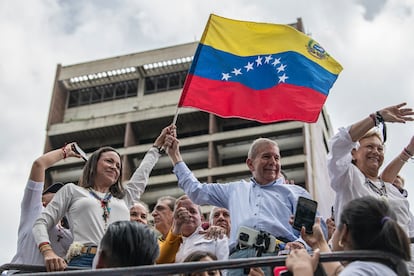
A. I can't sum it up in one word; it's a huge responsibility. It's a commitment not only to Venezuela, but to the entire world. I'm overwhelmed. I'm part of a movement of millions. I feel it's a little unfair to personify one figure when we have political prisoners, nine million exiles, thousands murdered, more than 20,000 extrajudicial executions since Chávez came to power. Here is a country that has given its very life for freedom. I take this as recognition of the Venezuelan people at the most important moment in our republican life.
Q. US President Donald Trump's name has been mentioned a lot in recent days as a possible winner of the award. You were one of the first people he's publicly thanked. Have you spoken to him?
R. Yes, we talked today.
Q. How did that conversation go?
A. It was a private conversation, and I prefer to leave it at that, but what I can say is that we Venezuelans are deeply grateful to President Trump. He has firmly and correctly assumed the nature of the regime we face. This is not a conventional dictatorship. This is a tyranny that has resulted in a narco-terrorist system. This is about dismantling a criminal system. This is about saving lives. And of course, from our perspective, it's about enforcing popular sovereignty. We won an election with perverse, extreme rules that probably wouldn't have been accepted in Spain or in most democratic countries around the world. And yet, we went and won by a landslide. That's where our greatest strength and legitimacy emerge.
Q. What is your position regarding the US attacks and military maneuvers off the Venezuelan coast? Do you fear they could jeopardize a peaceful solution in Venezuela?
A. The only way for a criminal structure to finally give in and accept that it has to leave is when you cut off its sources of financing. This is a regime that has financed itself through drug trafficking, gold smuggling, arms smuggling, human trafficking, the black market, and oil. The moment those flows begin to close, the structures begin to creak. That's what's happening in Venezuela today, and that's what we have to understand. All the people who said we shouldn't build a credible threat, that we shouldn't use force as our primary means—well, look at everything that's happening. This confirms what we've been saying for years: freedom must be conquered, and facing a tyranny of this kind requires moral, spiritual, and physical strength. We are facing the real possibility that Venezuela will truly liberate itself and move toward an orderly transition, because 90% of the population wants the same thing. Don't tell us this could be Libya, Afghanistan, or Iraq; it has nothing to do with it.
Q. And how far do you think that pressure can go?
A. That will depend on Maduro. Maduro has the opportunity to achieve peace. I tell him: “Maduro, go now for peace in Venezuela.”
Q. What do you expect from him and from Chavismo?
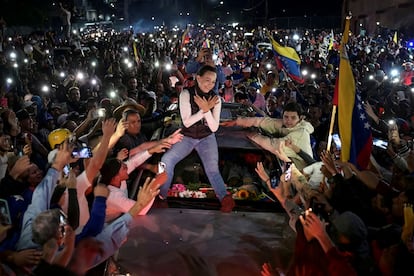
A. We're seeing what was predictable. They betray each other, they deceive each other, they betray each other. Every day that passes, more and more members of that circle realize that this is over and that for their own good they have to accept the terms of a transition. The person responsible for everything that's happening has a name, and it's Nicolás Maduro. And obviously the cartel, the cartel that has illegitimately taken over all of my country's institutions.
Q. What are the terms of this transition? How do you envision it?
A. It has many aspects. The most important is the people; they're at the heart of what we've done. We got here because of the people. Now they're telling us there can't be an orderly transition because there will be disruptive groups? It's going to be an absolutely orderly transition, and we're going to lead this country to stability thanks to the people, because we've earned it with our nails. It's a complex, extremely complex process. These guys destroyed everything. No one can tell you today how big the Venezuelan debt is, how much the reserves are, how much is exported, how much is produced. No one. What we can say is that it's the greatest plunder in the history of humanity.
Q. How viable do you think negotiations are? What gestures are you willing to make if Chavismo agrees to negotiate?
A. From the day we swept the election, we said we were willing to negotiate to bring justice to Venezuela. Never revenge or retaliation, because that's not who we are. Furthermore, the foundations of what was Chavismo are today the most passionate and fervent promoters of change in Venezuela, because they know the monster, because they don't want that for their children; because public employees, the military, and the police feel like and are political prisoners. No one has to be a friend of me or of Edmundo [González]. Our great desire is for our children to return home. I know that you love them in Spain and have welcomed them with open arms, but I can tell you in advance that I want them all back, and quickly.
Q. And what would be the red lines of a negotiation with the Chavista leadership?
A. I'm not going to go into those details, but I know that Venezuelans trust that we will carry out a process that will bring people, truth, and justice to the forefront. But we must take action to facilitate this process. We will take it and present it with absolute rigor and transparency. Transparency to the country. There is no one more interested than I in this process moving quickly, in an orderly manner, and at the lowest possible cost. Maduro decides whether to take it or leave it, but he will emerge with or without negotiations.
Q. You've been in hiding for over a year. How do you handle the distance from the streets? How does that relationship with isolation affect you when much of your life is spent in prison? And, above all, how do you maintain trust?
A. I confess that it has been very difficult, and if I had asked this question a year ago, I would have said: “You're crazy! I don't want even one week [of clandestinity]. There's nothing left.” And look at how we've been reinventing and innovating. The regime thought that the formidable structure we were building, the comanditos, with more than a million volunteers, didn't see it coming. They thought they were going to dismantle it with clubs, bullets, force, and repression. And yes, the cost has been brutal; there are 853 prisoners, thousands in hiding, and millions in exile. But while we had to protect ourselves, we immediately returned with new forms of organization—careful, stealthy, protecting one another, but very effective and powerful. If Venezuelan society has anything today, it's a level of organization like few other societies, despite having to do so clandestinely.
Q. How do you think Latin American powers like Brazil, Mexico, or Colombia would react to a hypothetical military incursion by U.S. forces into Venezuela? Or do you not see that scenario as viable?
A. The only invasion in Venezuela is the one we've had from the guerrillas, from the cartels of Cuban, Russian, and Iranian agents, Hezbollah, Hamas, and other organizations. And all the countries of Latin America and all the presidents of Latin America know what's happening here in Venezuela, and there's no excuse anymore. So today we're facing a country occupied by the forces of crime, and each of these governments, and in general all of them, have to make a decision: either they stand with the people of Venezuela or they stand with a narco-terrorist cartel.
Q. So you rule out a US military incursion.
A. I'm not going to comment on an operation of that nature, which seeks to defend the national security of any other country. We are defending the sovereignty and freedom of Venezuela, and we've had thousands and thousands and thousands of human lives lost in that process. And this recognition today is a recognition of each and every one of them: the political prisoners, their families, the human rights defenders, the Venezuelans around the world, but above all, our children, our youth, and the generations who will be born in a free Venezuela.