
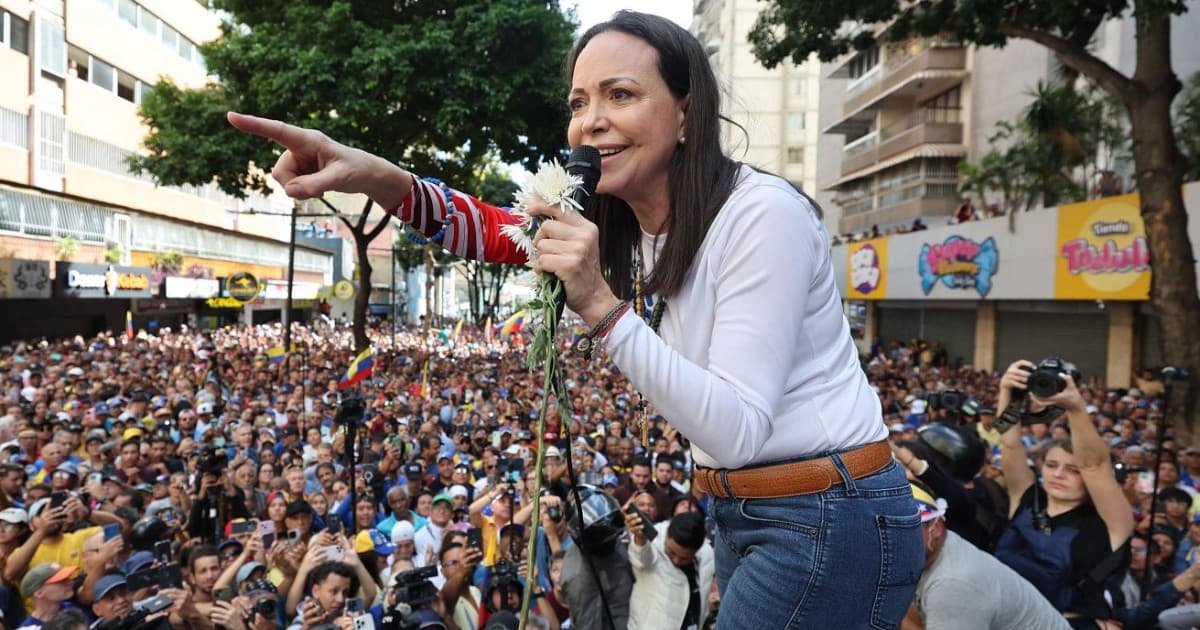
The news quickly spread around the world: María Corina Machado, one of the most visible figures of the Venezuelan opposition, has been awarded the 2025 Nobel Peace Prize. With this recognition, she becomes the second Latin American woman to receive it, after Rigoberta Menchú in 1992, and the second Venezuelan to win a Nobel Prize, after Baruj Benacerraf, who was awarded the Nobel Prize in Medicine in 1980. This award not only celebrates her personal trajectory but also restores Venezuela to a central role on the global stage, beyond the image of crisis and fractures that often accompanies it.
An industrial engineer by training, Machado founded the organization Súmate in 2002, dedicated to defending electoral transparency. Since then, her career has been marked by clashes and tensions with those in power: elected to the National Assembly (her famous clash with Hugo Chávez ) she was subsequently declared ineligible, harassed by legal proceedings, and designated an"internal enemy" of the state. In 2023, despite the political ban from the Maduro regime, she was overwhelmingly elected in the opposition primaries, cementing her position as a symbol of resistance in a country where democracy appears increasingly fragile.
The Norwegian Committee explained its decision by citing its defense of democracy, nonviolence, and human rights in the face of repression: a symbol of hope for millions of Venezuelans who for over twenty years have experienced the deterioration of institutions, forced migration, and restrictions on civil liberties. These citizens today see in this recognition their stories, their experiences, their struggles. In an international context in which the Gaza genocide and Putin's war on Ukraine monopolize attention, the prize brings Venezuela and Latin America back to the center of the debate on the necessary and possible democratic and peaceful transitions in the so-called Global South.
Like any prominent political figure, Machado divides public opinion and polarizes the masses. For some, he is the voice of courage and determination; for others, he represents an elitist approach, one distant from the most vulnerable sectors of the population, the face of a right-wing party very close to the US Republicans, with all the implications that entails. In this sense, the Nobel Prize he recently received does not resolve these potential contradictions, but rather repositions them, opening a reflection on what it means to defend democracy in authoritarian contexts and on the growing role of Latin American women in this struggle.
The parallel with Rigoberta Menchú is inevitable. While in 1992 the prize went to an indigenous woman committed to social justice in Central America, today it is awarded to a Venezuelan woman who has embodied resistance to a centralized and repressive political system. And the reference to Baruj Benacerraf, a science award winner, underscores how Venezuela is capable of offering the world figures of excellence and resilience in a wide range of fields, from medicine to politics.
The Nobel Peace Prize awarded to Machado should therefore not be read simply as an individual prize but also as an invitation to Latin America to question its own democratic weaknesses at a time when authoritarian discourses are forcefully resurfacing and structural inequalities continue to mark the daily lives of millions of people. It is a mirror that reflects a society struck by profound crises, yet capable of expressing leadership that speaks to the world and reminds us that democracy is not an abstract ideal, but rather a constant practice that requires risk, sacrifice, and courage.
2025 will likely be remembered as the year Venezuela returned to the international map, not for hyperinflation, nor for the migrant exodus, nor for the repression of protests, nor for the US naval operation (of dubious legitimacy under international law), but for the recognition of a woman who persevered in the defense of civil and social rights and liberties. A face that from today reflects that of millions of people convinced that, despite everything, democracy remains the only possible path to dignity and justice.
And, naturally, the decision does not leave regional and international political leaders indifferent. Trump (who perhaps had some hope) is displeased, Petro (aspiring world leader) is displeased, but above all Nicolás Maduro, for whom it is becoming increasingly difficult to sustain the narrative with which he has for years portrayed himself as a"martyr" besieged by the predatory hands of the North American empire. A discursive construct that deliberately ignores the forced exodus of millions of Venezuelans, the economic collapse, the entrenchment of drug trafficking, the systemic corruption, political repression, and torture documented by international bodies.
The Nobel Prize to Machado, in this sense, is not only an individual recognition, but a symbolic fracture that weakens the narrative legitimacy of the regime and strengthens its perception as an isolated power, incapable of concealing its responsibilities before the global community.