
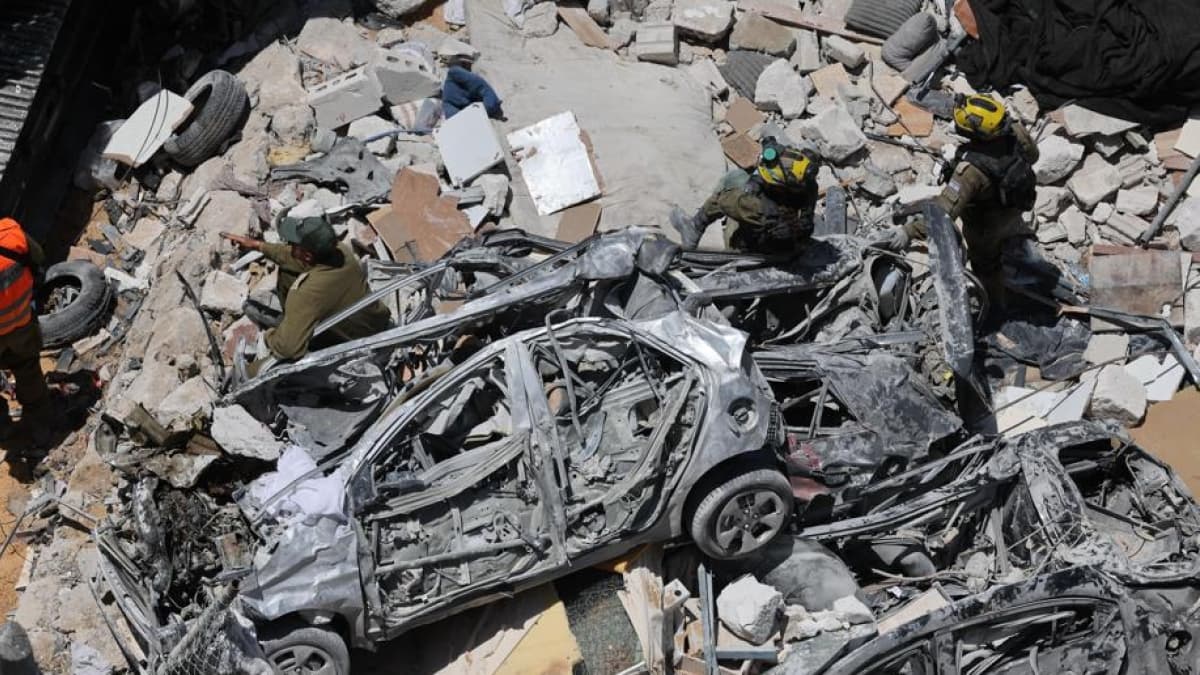
Israel built the program that led it to have (albeit unofficially) the atomic bomb with the help of France, since the 1950s: today in Israel no one speaks openly of resorting to it. Tehran has always denied wanting to get to the nuclear weapon, but the IAEA revealed that Iran had violated the agreements on enrichment
Israel, Iran and theatomic bomb : two completely different stories, which over time have become the web of threats weighing on the Middle East and are now at the centre of war chronicles. Israel built its nuclear programme in great secrecy thanks to French help starting in the early 1950s and with the idea from the very beginning that it would serve to prevent forever the risk of a second Holocaust. David Ben Gurion and the other founding leaders of the State christened it : a form of absolute deterrence, the weapon of all weapons that would leave no enemy a chance.
It was a very young Shimon Peres who negotiated the secret protocols of Sèvres with Paris in 1958, oiled two years earlier by the Israeli-French-British alliance in the failed war for the Suez Canal against Nasser, which led to the construction of the Dimona reactor, in the underground bunkers of the northern Negev desert. Washington was absolutely against it. President Dwight D. Eisenhower had forced the Israelis to withdraw from the Sinai and the Gaza Strip occupied in 1956 : he did not want dangerous adventurism that would put at risk the balance of the Cold War with Moscow and above all he was against nuclear proliferation. American intelligence therefore discovered the Dimona project only in the early Sixties, then tried to block it and send inspectors from the International Atomic Energy Agency (IAEA). He barely succeeded in 1965, but by then the underground facilities had been camouflaged and the inspection turned out to be a flop. The issue remained a hot topic for a long time, polluting Washington-Jerusalem relations.
Only the Nixon administration would then reluctantly accept the fait accompli. In the meantime, the Israeli atomic bomb was a reality. In 1967, it seems, there were about ten nuclear-tipped missiles in silos ready for launch. According to some sources, Jerusalem then thought of detonating one in the Sinai as a threat and deterrent to stop Egyptian troops shortly before the overwhelming Israeli victory in the Six-Day War. Six years later, when Egyptian and Syrian troops unleashed the Yom Kippur War, Golda Meir's government in a panic ordered the opening of the Dimona silos with the nuclear-tipped missiles ready for launch and this convinced the Americans to start the airlift for the rapid delivery of conventional weapons needed to repel the invaders.
Pro-Western Iran in the era of Shah Reza Pahlavi moved later on nuclear power than Israel and in broad daylight. But above all, it did so in full coordination with Washington. Initially, there was talk of the Atoms for Peace project aimed at scientific research. In the early 1970s, plans were made to build about twenty nuclear power plants, which would produce clean energy at low costs for purely civilian purposes. At that time, Israel and Iran were on the same side against the Arab world. However, everything changed with the Khomeini revolution of 1979. The taking of American diplomats hostage in the Tehran embassy and the violent anti-Zionist preaching marked a radical turning point. From then on, the prospect of an atomic bomb at the service of Shiite Islamic radicalism became a constant concern for the Jewish state, for the United States and for most Sunni governments, with Saudi Arabia at the forefront. After Khomeini, Supreme Leader Ayatollah Ali Khamenei has repeatedly reiterated the need to annihilate Israel.
The destabilization triggered by the Green Revolution in Tehran highlighted what had previously been underestimated: the lack of shared rules and agreements made the framework highly unstable. And the underlying problem has not changed. The Israeli authorities have never even officially recognized that they possess unconventional weapons. As a result, the governments in Jerusalem have not joined the international Treaty on the Non-Proliferation of Nuclear Weapons (NPT), which has sought to limit the threat since 1968. Tehran, on the contrary, has signed it, but has not recognized it since 1979. The consequences are clear: ambiguity reigns supreme and this creates the conditions for uncontrolled proliferation. The Ayatollahs' Iran was secretly helped by Pakistan and North Korea to develop its nuclear programs.
In Israel, where the freedom of an open society reigns, censorship has the right to block the publication of information on the subject and even prosecute journalists, writers, military personnel, state officials and anyone who confirms the existence of atomic weapons. IAEA inspectors have never set foot in Dimona or any other nuclear site. Today foreign observers, avoiding directly citing their sources in Israel, estimate that the atomic bombs are between 90 and 400 in number and can be launched by missiles, even long-range ones (the most up-to-date Jericho model is estimated to exceed 11,500 kilometers), by submarines and by the air force.
In Khomeini’s Iran, the IAEA was severely restricted, but continued to operate. Russia sent nuclear experts to Tehran in the early 1990s. In 2002, Iranian opposition activists abroad denounced that the regime was trying to build the atomic bomb, pointing the finger at the Natanz base for uranium enrichment. The most important reactor sites and uranium storage facilities had been hidden in deep tunnels. The following year, Khamenei issued a fatwa banning nuclear weapons as un-Islamic. However, Israel and the United States soon raised serious doubts that it was actually being implemented, leading the international community to step up sanctions. In the following years, the IAEA accused Iran of reticence and non-cooperation: there was a suspicion that there were secret programs for enriching uranium for military purposes. During the presidency of Mahmud Ahmedinejad, nuclear defense became an integral part of the national rebirth and on April 11, 2006, he himself announced on television the team of scientists to enrich uranium. From then on, open war broke out between the international inspectors and the regime, it became obvious that Iran was rapidly approaching the atomic bomb. The periodic reports of the IAEA were alarming.
But in 2014 Barack Obama and his European partners made a direct commitment to reach an agreement with Tehran. Was this the turning point? Many diplomats in Europe were convinced of it. On 14 July 2015, the agreement limiting Iranian nuclear proliferation was signed with international supervision. In January 2016, it was announced that Iran had respected the agreements and the sanctions could be lifted. But in 2018, the Israeli Mossad declared that it had stolen the nuclear archives in the district of Turquzabad in Tehran, which proved that the Iranians were actually secretly continuing to build the atomic bomb. And this convinced Donald Trump to cancel the agreement from three years earlier and reimpose the sanctions. European diplomacy and a large part of the international community harshly criticized that choice, which in fact marginalized Iran and pushed the hawks of its regime to resume nuclear projects in great secrecy. The IAEA’s February 2019 statement that Iran was still complying with the agreements was to no avail. In the face of the wall, Tehran announced in May that its nuclear program was resuming in full, without limits. This coincided with a long series of Mossad attacks on Iranian nuclear sites and scientists working there.
Among the high-profile deaths was also Mohsen Fakhrizadeh, the head of the project, assassinated in Tehran on November 27, 2020. In the October 2023 report, the IAEA reported that Iran's uranium reserves had grown 22 times compared to 2015 and that the work of inspectors was continually hindered. These concepts were reiterated in recent days. Although there is really no concrete evidence that Iran is close to having the Bomb. Was Iran really developing the atomic bomb?, the Financial Times asks on its front page today, recalling that Benjamin Netanyahu has been trying to convince the world of the imminence of Tehran's atomic threat since 2012. The paradoxical aspect of all this is that, until the surprise Israeli attack a few days ago against Iran, Donald Trump was trying to restore a nuclear agreement not very different from the one concluded in 2015 and broken by him in 2018. And one of the political reasons for Netanyahu to attack now was precisely to prevent this from happening. Since 2018, the question that the Iranians have been repeating has not changed: How come Israel can have the atom bomb and we can't?
Today in Israel no one is openly talking about resorting to the atomic bomb and the reference last November to its use against Gaza by Minister Amichai Eliyahu was immediately silenced by the government, but even among international observers it is believed that the events of the last few weeks could induce the Iranian regime to accelerate its nuclear program.